Why a Chipmaker Is Buying an AI Research Lab: Inside AMD’s $8.2 Billion World Labs Bet
AMD’s planned $8.2 billion acquisition of Fei-Fei Li’s World Labs is more than another AI deal. By bringing spatial-intelligence researchers inside the company, AMD could gain an earlier view of the workloads its future chips, software and computing systems may need to support.
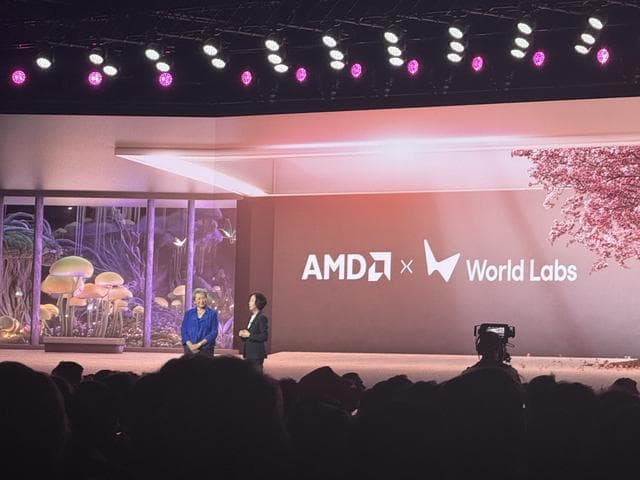
Why would a chipmaker buy an AI research lab?
AMD’s planned $8.2 billion acquisition of World Labs can be read as another large transaction in the AI industry. But the more important question is why a semiconductor company wants to own a frontier AI research lab.
AMD already builds processors and accelerators designed to run increasingly demanding computing workloads. World Labs operates closer to the model layer, developing spatial-intelligence systems intended to understand, generate and reason about three-dimensional environments.
Bringing those capabilities together could create a closer connection between the researchers developing new AI systems and the engineers designing the computing platforms on which those systems may eventually run.
That relationship could be one of the most important parts of the deal.
From supplying compute to understanding future workloads
The AI infrastructure boom has created enormous demand for GPUs and other specialised computing systems.
But semiconductor companies face a difficult problem. Chips take years to design, while AI models and their computational requirements can change rapidly.
World Labs could give AMD greater visibility into that evolution.
If researchers inside AMD are developing spatial-intelligence models, the company could observe where computational bottlenecks emerge, how much memory these systems require, how data moves through the system and which operations demand the most compute.
Those research problems can eventually become semiconductor architecture problems.
The strategic value of World Labs may therefore lie not only in the models it develops, but in what those models can tell AMD about the computing architectures that could be needed next.
Why spatial intelligence matters
Much of the current AI boom has centred on systems that generate and process text, images, audio and video.
Spatial intelligence introduces another challenge: enabling AI systems to understand and reason about three-dimensional environments.
That capability could become important for robotics, autonomous systems, industrial simulation, digital twins and other forms of physical AI.
These workloads may not behave exactly like today's dominant large language models.
Systems operating in physical environments may need to process information about objects, movement, geometry and changing surroundings. Training these systems could require substantial data-centre infrastructure, while inference could eventually take place across cloud platforms, factories, vehicles and robots.
For AMD, this creates a potentially broader computing opportunity.
AMD is building more than GPUs
The acquisition also needs to be viewed within AMD’s wider AI strategy.
AMD increasingly competes at the system level rather than simply selling individual processors. Its AI portfolio spans Instinct accelerators, EPYC CPUs, ROCm software, networking technologies and rack-scale computing infrastructure.
That matters because modern AI performance is not determined by the accelerator alone.
Memory bandwidth, networking, software, power consumption, cooling and communication between large numbers of processors all affect how efficiently AI workloads can operate.
Bringing AI researchers closer to the teams designing these systems could allow AMD to examine future workloads from both sides of the problem: the models being developed and the infrastructure required to run them.
The physical AI infrastructure question
There is a broader infrastructure implication.
Today's AI data-centre expansion has largely been driven by training and serving generative AI models. That has already pushed operators toward higher accelerator density, advanced networking, liquid cooling and increasingly large power requirements.
Physical AI could broaden the infrastructure landscape further.
Training and simulation could remain concentrated in large computing clusters, while inference may increasingly occur closer to machines operating in the physical world.
If that happens at scale, demand could spread across data centres, cloud infrastructure, industrial facilities and edge computing systems.
The implications would extend beyond AMD. Cloud providers, data-centre operators, networking companies, power suppliers and cooling providers would all have to respond to the computational characteristics of these workloads.
It is still too early to quantify that opportunity.
What does AMD get for $8.2 billion?
The acquisition price creates another important question.
AMD is committing approximately $8.2 billion in stock to an emerging area whose eventual commercial scale is still uncertain.
The value of the transaction therefore cannot be judged only by World Labs' near-term revenue.
AMD is also acquiring research talent, intellectual property and direct exposure to the development of a potentially important new category of AI models.
If spatial intelligence becomes foundational to robotics, simulation and physical AI, understanding its computational requirements early could be valuable to a semiconductor company whose products must be designed years before deployment.
But that outcome is not guaranteed.
What to watch next
The strongest evidence about the value of this acquisition will emerge after the transaction closes.
One question is how closely World Labs researchers work with AMD’s semiconductor, software and systems engineering teams.
Another is whether AMD begins identifying specific hardware requirements emerging from spatial-intelligence workloads.
It will also be important to watch whether World Labs research eventually influences Instinct accelerators, ROCm, networking technologies or AMD’s rack-scale systems.
Finally, there is the commercial question: whether spatial intelligence and physical AI develop into workload categories large enough to materially influence global computing infrastructure investment.
Until those answers emerge, the acquisition should not be treated as evidence that AMD has secured a leadership position in physical AI.
It is better understood as a strategic signal.
AMD appears to be moving closer to the research that could determine what future AI infrastructure needs to become, rather than waiting for those computing requirements to emerge after the models have already been built.
Sources
AMD
AMD to Acquire World Labs to Advance the Future of AI Compute
World Labs
World Labs
Atlas: A World Model for Spatial Intelligence
Topics
- AI
- Compute
- Robotics
- Semiconductors
Related
NVIDIA Is Moving AI-Agent Security Into the Infrastructure Layer. What Changes?
Sep 28, 2026 · 3 min read
The Economics Behind the AI Data-Centre Boom: What Nscale’s IPO Reveals
Sep 21, 2026 · 10 min read
700 Data Centres by 2035: What Would It Take for Nigeria to Keep Up?
Sep 21, 2026 · 10 min read