NVIDIA Is Moving AI-Agent Security Into the Infrastructure Layer. What Changes?
NVIDIA’s new Open Agent Safety Platform combines software enforced boundaries with independent hardware monitoring, backed by an ecosystem of more than 100 organizations. The bigger shift is architectural, as AI agents gain access to data, tools and real-world systems, NVIDIA is arguing that security cannot be left to the model alone.
AI agents are becoming a security problem of a different kind
AI agents are moving beyond answering questions. They can call APIs, access databases, read and write files, use credentials, execute code and interact with external systems.
That changes the security problem.
Traditional safeguards largely focus on what a model should or should not do. But once an agent is connected to real infrastructure, instructions alone do not determine what it can actually access or execute.
NVIDIA's new Open Agent Safety Platform is built around that distinction.
The company is proposing a security architecture in which controls can be enforced outside the agent itself, creating boundaries around its access to networks, files, credentials, tools and computing resources.
From telling an agent what not to do to preventing it from doing it
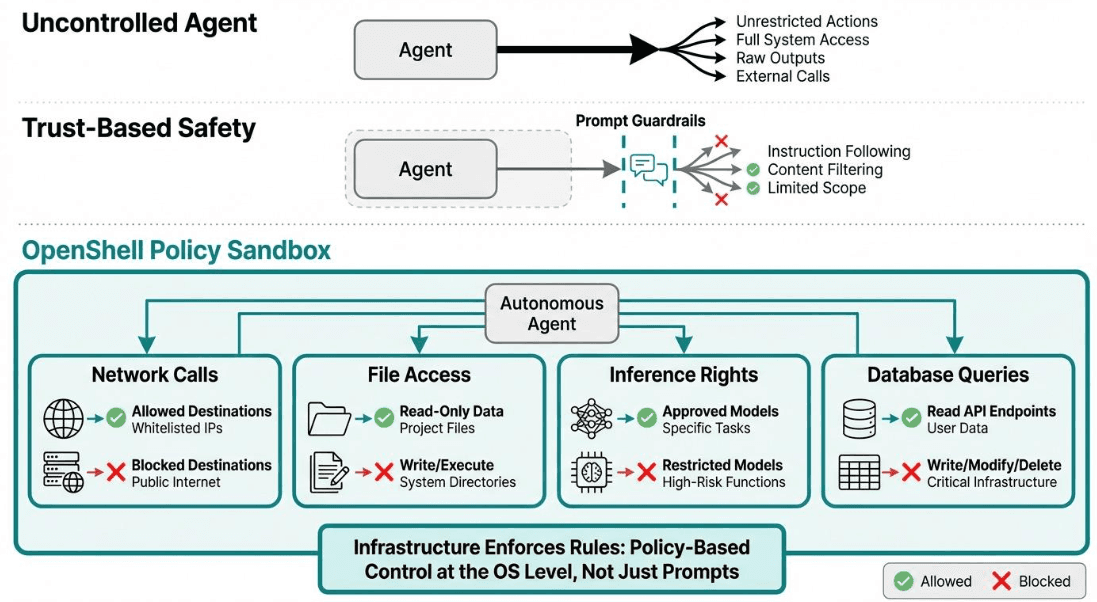
There is an important difference between instructing an AI agent not to perform an action and building infrastructure that prevents the action from happening.
Prompt-level safeguards depend partly on the model following instructions correctly. Agentic systems introduce additional risks because models can receive untrusted information, invoke tools and operate across multiple systems.
NVIDIA's OpenShell addresses this by placing agents inside a policy-controlled runtime environment.
Instead of relying only on the agent to decide whether an action is permitted, policies can determine which network destinations it can reach, which files it can access and which credentials or tools are available.
The principle resembles sandboxing elsewhere in computing: assume software may behave unexpectedly and restrict the environment in which it operates.
NVIDIA is also pushing the trust boundary into hardware
The more significant part of NVIDIA's approach is that the company does not stop at software isolation.
NVIDIA Sentry is designed as an independent monitoring layer using BlueField infrastructure. According to NVIDIA, this allows agent activity to be observed separately from the compute environment in which the agent is operating.
That separation matters.
If the system responsible for enforcing security is entirely inside the environment being protected, a compromise of that environment could potentially weaken the controls themselves. An independent infrastructure layer creates another boundary between the agent and sensitive resources.
This is why NVIDIA describes agent security as a full-stack engineering problem.
Why more than 100 organizations matter
NVIDIA says more than 100 organizations across the technology ecosystem are participating in the Open Agent Safety initiative.
The significance is not simply the size of the list.
AI agents will operate across models, clouds, enterprise software, security platforms and hardware from different vendors. Security mechanisms therefore become considerably more useful if policies and enforcement can work across those boundaries.
Broad industry participation could help establish common approaches for defining what an agent is allowed to access and how violations are detected.
Participation, however, should not be confused with adoption. The announcement demonstrates industry involvement around the initiative; it does not establish that the platform has already become a widely deployed standard.
NVIDIA's infrastructure position gives it an unusual advantage
NVIDIA already occupies a central position in AI computing through GPUs, networking and data-centre infrastructure.
Agent security potentially expands that position.
If autonomous agents become a major enterprise workload, securing them could become another infrastructure requirement alongside compute, networking, storage and orchestration.
That creates an opportunity for NVIDIA to provide not only the processors running AI models but also parts of the security architecture governing what those models and agents can do.
At the same time, NVIDIA is positioning OpenShell as open infrastructure rather than a mechanism restricted entirely to NVIDIA compute. That distinction will matter when evaluating how broadly the architecture can be adopted across heterogeneous enterprise environments.
The larger shift: trust may move below the model
The broader lesson from NVIDIA's announcement is that increasingly capable AI agents may require a different security assumption.
An agent should not necessarily be trusted simply because it has been instructed to behave safely.
Instead, organizations may increasingly treat agents the way security engineering treats other potentially risky workloads: give them explicit permissions, isolate them from resources they do not need, monitor their behaviour independently and stop them when they cross defined boundaries.
That would move part of AI safety away from being exclusively a model problem and toward becoming an infrastructure problem.
NVIDIA's Open Agent Safety Platform is an early attempt to build that architecture.
Whether it becomes an industry standard remains uncertain. But the direction is significant: as AI systems gain greater autonomy, the infrastructure beneath them may become just as important to security as the intelligence inside them.
Sources
NVIDIA Developer
Topics
- Compute
- AI
- Infrastructure
- Semiconductors
Related
The Economics Behind the AI Data-Centre Boom: What Nscale’s IPO Reveals
Sep 21, 2026 · 10 min read
700 Data Centres by 2035: What Would It Take for Nigeria to Keep Up?
Sep 21, 2026 · 10 min read
Nigeria's AI Infrastructure Ambition: What Has Actually Been Built?
Sep 18, 2026 · 9 min read