The Economics Behind the AI Data-Centre Boom: What Nscale’s IPO Reveals
Nscale’s IPO filing offers a rare look inside the economics of the AI data-centre boom, revealing rapid revenue growth alongside heavy losses and enormous infrastructure commitments. What does it tell us about the cost and potential payoff of building AI compute at scale?
The Economics Behind the AI Data-Centre Boom: What Nscale’s IPO Reveals
Artificial intelligence may be built in software, but scaling it has become an increasingly physical business.
Behind the models are GPUs, power systems, cooling equipment, networking infrastructure and data centres that can cost billions of dollars to bring online. The race to secure those resources has created a new class of infrastructure companies attempting to turn unprecedented demand for AI compute into long-term businesses.
Nscale is one of them.
On September 18, 2026, the London-based AI infrastructure company filed a registration statement with the U.S. Securities and Exchange Commission for a proposed initial public offering on the New York Stock Exchange under the ticker NSCL. The number of shares and proposed price range had not yet been determined at the time of filing.
The IPO itself is significant. But the more interesting story is contained inside the filing.
Nscale reported $140.6 million in revenue during the first six months of 2026, compared with $10.4 million during the same period a year earlier. At the same time, it recorded a net loss of approximately $1.02 billion.
Those numbers appear contradictory at first: extraordinary revenue growth alongside an even larger loss.
They make more sense when Nscale is viewed not simply as a cloud company, but as an infrastructure developer trying to build enormous amounts of AI compute before much of its contracted demand can become operating revenue.
That distinction offers a useful window into the economics of the wider AI data-centre boom.
Revenue Is Growing Faster Than the Infrastructure Beneath It
Nscale is still a young company, but its revenue trajectory illustrates how quickly demand for dedicated AI compute has developed.
Revenue increased from $19.1 million in 2024 to $33.0 million in 2025. Then, in only the first six months of 2026, revenue reached $140.6 million.
That acceleration matters, but current revenue tells only part of the story.
As of August 31, Nscale reported approximately $2.6 billion of active total contract value, or TCV. When contracted capacity that had not yet become active was included, the figure increased to $103.4 billion. At the end of 2025, active and contracted TCV had stood at $38.0 billion.
The scale of that increase illustrates the level of demand Nscale has been able to contract.
It does not mean Nscale has earned $103.4 billion.
TCV represents the value associated with long-term contracts. Revenue is recognized as the underlying services are delivered. A contract for future AI capacity can therefore contribute to TCV long before the corresponding data centre, power infrastructure and GPU systems are fully operational.
This distinction is critical when evaluating the economics of the business.
Nscale has secured a very large pipeline of future business. Its challenge is converting that pipeline into functioning infrastructure and, ultimately, recognized revenue.
25,000 GPUs Today, 461,000 Active and Contracted
The difference between current operations and future commitments becomes clearer when looking at Nscale's compute capacity.
As of August 31, the company reported approximately 461,000 GPUs as active or contracted. Only a fraction of the infrastructure represented by its broader contracted pipeline was already active.
Recent reporting based on the prospectus puts Nscale's active data-centre capacity at 55 MW, compared with another 1.31 GW of contracted capacity.
That gap is one of the most important numbers in the IPO.
It demonstrates that much of Nscale's economic proposition depends not on infrastructure already producing revenue, but on infrastructure that still has to be financed, constructed, equipped and brought into service.
The same pattern can be seen across the AI infrastructure market. Demand can be contracted faster than physical capacity can be built.
A customer can sign an agreement relatively quickly. Delivering hundreds of megawatts of AI compute is considerably harder.
Land must be secured. Power has to be available. Data centres must be built or retrofitted. GPUs need to be purchased and installed. Networking, storage and cooling systems must be integrated. Only then can much of the contracted capacity begin producing revenue.
In other words, the backlog is valuable precisely because demand exists. But it also represents an enormous execution obligation.
The $103 Billion Number Needs Context
Nscale's $103.4 billion of active and contracted TCV is likely to attract considerable attention.
It should.
For a company that generated $140.6 million of revenue in the first half of 2026, a contract-value figure above $100 billion illustrates the extraordinary scale at which AI infrastructure is being reserved.
But the two numbers should not be compared as though they represent the same thing.
Only about $2.6 billion of Nscale's TCV was classified as active as of August 31. The much larger $103.4 billion figure includes capacity contracted for future delivery.
The economic value of those agreements therefore depends on execution.
Nscale has to bring the required infrastructure online, deliver the contracted compute capacity and maintain those systems over the life of the agreements.
This is where the AI infrastructure boom becomes more complicated than a simple story about demand.
Demand may already be contractually visible. The infrastructure required to satisfy it may not yet exist.
That gap between signed demand and deployed capacity is where financing, construction and execution risk accumulate.
Why a Fast-Growing Company Can Still Lose $1 Billion
Nscale's $1.02 billion net loss for the first half of 2026 looks striking next to $140.6 million of revenue. A year earlier, the company reported a net loss of $368.9 million on $10.4 million of revenue.
The figures underline the capital intensity of the sector, although a net loss should not be treated as a simple proxy for the amount spent building data centres. Accounting losses can include financing costs, non-cash items and other expenses in addition to direct infrastructure investment.
Still, Nscale's disclosed commitments show the scale of the physical build-out ahead.
Reporting based on the prospectus says the company has committed roughly $3.5 billion to construction and support services and another $24 billion for technology equipment across its sites, with payments due through 2026 and 2027.
That creates a fundamental timing problem.
AI infrastructure companies often have to spend enormous amounts of money before the infrastructure they are building can generate its expected revenue.
A GPU cluster cannot generate compute revenue before it is deployed. A data centre cannot host that cluster before sufficient power and cooling are available. And a site with future power rights does not produce the same economics as a fully operational facility.
The result is a business model in which future contracted demand can be enormous while present capital requirements remain equally significant.
AI Compute Is Also a Power Business
Perhaps the most revealing part of Nscale's filing is how prominently electricity appears in its strategy.
The company describes access to reliable, large-scale contiguous power as the primary gating factor for AI infrastructure deployment.
That tells us something important about where the AI industry is heading.
For years, competition in artificial intelligence was discussed primarily in terms of algorithms, model architectures, training data and semiconductor performance.
At hyperscale, another variable increasingly determines what can actually be deployed: power.
Nscale has responded by moving deeper into the energy layer of the infrastructure stack. Its acquisition of American Intelligence & Power Corporation included the Monarch Compute Campus in West Virginia, which Nscale says has a power-generation capacity runway scalable to more than 6.5 GW of IT load power and more than 8 GW of gross power. The company subsequently created an Energy & Power division.
The logic is straightforward.
Owning GPUs without access to sufficient electricity limits deployment. Having data-centre land without grid capacity creates the same problem. Securing both compute hardware and power therefore becomes part of the competitive advantage.
AI infrastructure is consequently beginning to resemble an intersection of cloud computing, semiconductor deployment, industrial construction and energy development.
That is a much more capital-intensive system than conventional software.
Financing the Build-Out
The next question is how all of this infrastructure gets financed.
Nscale has increasingly turned to large financing arrangements tied to individual deployments.
On August 31, the company announced approximately $3 billion in aggregate commitments across two senior secured delayed-draw term-loan facilities supporting projects in Ward County, Texas, and Madison, North Carolina.
Up to $1.85 billion is intended for the Ward County campus, including GPU infrastructure, networking, storage and liquid-cooling equipment supporting approximately 200 MW of IT load.
Another facility of up to $1.2 billion supports the North Carolina site and is intended to finance retrofit capital expenditure, GPU infrastructure and associated networking.
Those facilities are not isolated examples.
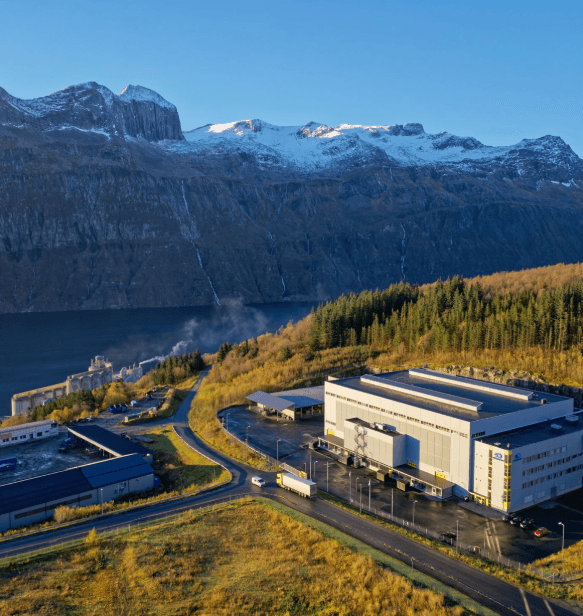
In May, Nscale announced another $790 million financing commitment supporting its AI data-centre development in Narvik, Norway. That followed a $2 billion Series C financing round in March and a $1.4 billion delayed-draw term loan announced in February.
The pattern reveals an important feature of the AI infrastructure economy.
Long-term customer contracts can provide visibility into future demand, but companies still need enormous amounts of capital to build the infrastructure required to serve those contracts.
Debt, equity and project-level financing therefore become part of the compute supply chain.
The AI boom is not being financed only by technology budgets. It increasingly depends on capital markets.
The Customer Concentration Question
Rapidly growing contract value also creates another issue: who is buying the capacity?
Nscale's filing shows substantial customer concentration. Its largest customer accounted for 52 percent of revenue during the first half of 2026.
Concentrated customers can be advantageous during rapid expansion. Large hyperscalers and AI laboratories can sign contracts substantial enough to justify major infrastructure projects.
But concentration also creates dependency.
If a small group of customers represents a large portion of revenue or contracted capacity, changes in their AI spending, deployment schedules or infrastructure strategies can have outsized effects on the supplier.
The strength of long-term contracts can reduce some demand uncertainty, particularly where agreements contain take-or-pay provisions. It does not eliminate construction, financing, counterparty or operational risk.
For investors examining Nscale, the quality and structure of those contracts may therefore matter almost as much as their headline value.
What the IPO Actually Reveals
Nscale's filing does not prove that the AI data-centre boom is either economically sustainable or unsustainable.
It reveals something more useful.
The economics of AI infrastructure are increasingly built around a race between contracted demand and physical deployment.
On one side are enormous commitments from companies seeking access to compute.
On the other are the physical constraints required to deliver it: GPUs, electricity, cooling, networking, land, construction capacity and financing.
Nscale currently sits in the middle of those forces.
Its revenue growth shows that real demand is already translating into business. Its $103.4 billion of active and contracted TCV suggests that customers expect substantially more capacity in the years ahead.
But the gap between active infrastructure and contracted infrastructure shows how much still has to be built.
That is the central economic question behind the IPO.
Not whether demand for AI compute exists. The contracts indicate that it does.
The harder question is whether Nscale can deploy infrastructure quickly enough, finance it efficiently enough and operate it profitably enough to convert that demand into durable returns.
The Infrastructure Behind the AI Boom
The AI industry is often described through models and chips.
Nscale's filing shows why that picture is incomplete.
The next phase of AI development increasingly depends on an industrial system connecting energy generation, data centres, semiconductor supply, networking, cooling, cloud software and global capital.
Every new cluster has to be powered. Every GPU has to sit somewhere. Every long-term compute agreement ultimately has to become physical infrastructure.
That makes Nscale's IPO more than a public-market event for one company.
It provides a snapshot of the financial machinery being assembled beneath the AI boom.
More than $100 billion of active and contracted TCV sounds extraordinary. So does a $1 billion six-month net loss. Neither number tells the whole story by itself.
Taken together, they reveal the scale of the bet being made.
AI companies are committing to enormous amounts of future compute. Infrastructure providers are committing enormous amounts of capital to deliver it. Investors and lenders are providing much of the financing connecting the two.
Whether those economics ultimately work will depend on what happens between the contract and the operating data centre.
For Nscale, that is where the IPO story really begins.
Sources
U.S. Securities and Exchange Commission
Nscale Global Holdings Ltd. Registration Statement (Form S-1)
Reuters
AI cloud firm Nscale files for U.S. IPO
Topics
- AI
- Compute
- Infrastructure
Related
700 Data Centres by 2035: What Would It Take for Nigeria to Keep Up?
Sep 21, 2026 · 10 min read
Nigeria's AI Infrastructure Ambition: What Has Actually Been Built?
Sep 18, 2026 · 9 min read
From Vision to Infrastructure: What Would It Take to Build the Future Elon Musk Shared?
Sep 20, 2026 · 5 min read