Nvidia’s China AI Chip Share Falls to 34%: Huawei’s Rise and the Limits of Market Share
IDC figures reported by Reuters show Nvidia’s share of China’s data-centre AI accelerator shipments at 34% in the first half of 2026, compared with Huawei’s 28%. The shift reveals how export controls, domestic suppliers and changing chip architectures are reshaping the market—but not necessarily which company has the strongest technology.
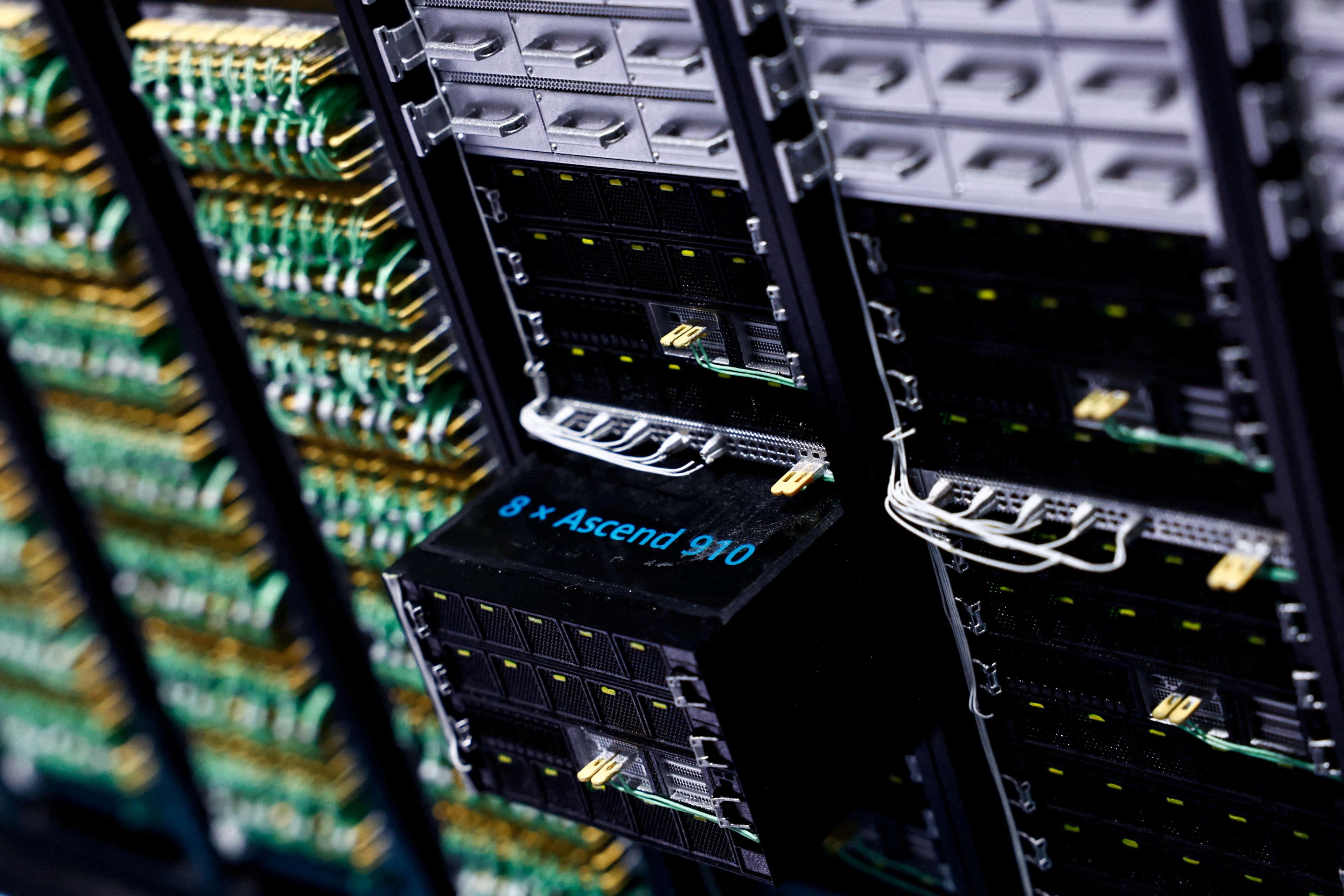
Nvidia's position in China's artificial intelligence hardware market is changing. The company remains the country's largest individual supplier of data-centre AI accelerators by shipment volume, but the gap between Nvidia and domestic rival Huawei has narrowed sharply.
According to figures from research firm IDC, reported by Reuters on October 13, 2026, Nvidia accounted for 34% of China's data-centre AI accelerator shipments in the first half of 2026. Huawei held 28%.
Nvidia shipped approximately 678,000 accelerators between January and June, a decline of 44% from the same period a year earlier. Huawei shipped 572,000 units, up from more than 300,000 in the first half of 2025.
The development raises a consequential question for the global semiconductor industry: Does Huawei's growing shipment share indicate a narrowing technological gap with Nvidia, or does it primarily reflect a market being reorganised by export restrictions, government policy and changing customer demand?
The available evidence suggests that these forces must be examined separately.
What IDC's Shipment Data Shows
The figures describe a competitive market in which domestic Chinese semiconductor designers are expanding their presence.
According to IDC estimates cited by Reuters, the distribution of China's data-centre AI accelerator shipments in the first half of 2026 was as follows:
The figures, which are rounded, place Nvidia ahead of Huawei by six percentage points.
They also show that competition extends beyond the two companies. Alibaba, Cambricon, Baidu and Hygon are developing domestic accelerator alternatives, creating a more diversified Chinese supplier base.
Nine of the eleven Chinese chipmakers tracked by IDC reportedly increased shipments compared with a year earlier.
However, these figures measure accelerator units shipped into the market. They should not be confused with revenue share, available computing capacity, chips currently operating in data centres or the commercial value generated by AI workloads.
A supplier can lead in unit volume while another delivers more computing performance per system. Conversely, a technically capable accelerator does not necessarily offer the most competitive deployment option once software compatibility, procurement constraints and operational costs are considered.
Export Controls Are Reshaping the Competitive Environment
US export controls are central to understanding Nvidia's changing position.
Washington has restricted China's access to some of Nvidia's most advanced AI processors, limiting the products the company can legally supply to Chinese customers.
These restrictions affect competition independently of customer preferences or relative technological capabilities. Even when a Chinese customer might prefer a particular Nvidia processor, export rules can prevent that processor from being supplied.
China has simultaneously promoted domestically designed semiconductors and introduced approval requirements affecting imports of certain export-compliant Nvidia chips.
The result is a market in which the availability of hardware is influenced by government decisions on both sides.
Nvidia CEO Jensen Huang has criticised US export restrictions, arguing that they risk transferring commercial opportunities from American semiconductor suppliers to Chinese competitors.
That argument is commercially significant, but IDC's shipment figures alone cannot establish how many customers would have chosen Nvidia products in the absence of those restrictions.
A counterfactual assessment would require evidence about procurement preferences, unconstrained product availability, prices, workloads and purchasing decisions.
Nevertheless, the reported reduction in Nvidia's shipments, alongside increased deliveries from domestic suppliers, demonstrates how regulatory restrictions can alter the composition of an AI hardware market.
Huawei's Rise Does Not Automatically Establish Performance Parity
Huawei's reported shipment growth is notable. Moving from more than 300,000 accelerators in the first half of 2025 to 572,000 in the corresponding period of 2026 indicates substantial expansion.
But chip shipments are only one dimension of competitiveness.
Modern AI infrastructure depends on several interacting components: processing hardware, high-bandwidth memory, networking, system architecture, software libraries, model compatibility, power consumption and operational reliability.
Nvidia's competitive position also rests on its CUDA software ecosystem, which has become deeply embedded in AI development and deployment workflows.
Huawei has its own AI computing architecture and software tools, including its Ascend accelerators and CANN development ecosystem.
For Chinese enterprises considering a transition between these platforms, relevant questions include how efficiently their models run, how much code must be adapted, whether common frameworks are supported, and how systems behave when thousands of accelerators operate together.
A meaningful technical comparison would examine sustained training and inference throughput, interconnect performance, memory capacity, power efficiency, system reliability, software support and cost per completed workload.
The IDC shipment figures reported by Reuters do not provide that comparison.
Consequently, Huawei's growing market share should not be presented as proof that its accelerators have matched or surpassed Nvidia's leading hardware in overall technical performance.
The More Important Shift May Be Beyond GPUs
One of the most revealing findings concerns the changing composition of China's AI accelerator market.
Reuters reported IDC figures indicating that shipments of non-GPU accelerators grew by approximately 80% year over year in the first half of 2026.
GPU shipments, by contrast, fell 26% to 991,000 units.
This distinction matters because AI acceleration is no longer limited to general-purpose GPU architectures.
Specialised processors can be designed to serve particular inference or other computational workloads. Their economics depend on workload requirements, supported numerical formats, memory access patterns and software integration.
Some applications benefit from flexible, programmable GPU systems. Others may be well suited to application-specific accelerators that prioritise efficiency for a narrower group of operations.
A shift toward non-GPU accelerators, therefore, does not automatically signify a decline in the technological relevance of GPUs.
Instead, it may reflect a market in which organisations are purchasing different hardware for different computational purposes, alongside the influence of product availability and industrial policy.
IDC also pointed to a growing emphasis on performance at the level of complete computing systems rather than individual chip specifications.
This is a consequential distinction. For large AI deployments, the value of an accelerator depends on how successfully it operates within a complete infrastructure environment.
Why System-Level Performance Matters
Comparing AI processors by individual chip performance can obscure the limitations of large-scale deployments.
A production AI system depends on compute hardware, memory, networking, storage, cooling, power delivery and orchestration software working together.
For model training, communication between accelerators can become a significant bottleneck. During inference, performance may depend heavily on memory bandwidth, latency requirements and the ability to serve simultaneous requests efficiently.
As infrastructure grows, reliability and resource utilisation also become important.
These considerations mean that the number of accelerators purchased cannot be translated directly into an equivalent amount of usable AI computing capacity.
Two organisations could deploy the same number of accelerators yet achieve substantially different throughput, operating costs and model-serving performance.
For Huawei and other Chinese chip designers, the challenge is therefore not only to increase silicon output, but also to support competitive and reliable computing systems across relevant workloads.
For Nvidia, defending its commercial position extends beyond selling processors. It involves maintaining advantages across hardware, networking, developer tools and infrastructure integration.
What the Figures Mean for the Global AI Industry
China's AI accelerator market is becoming a significant test of how technological competition behaves under geopolitical constraints.
For years, the global AI infrastructure industry has benefited from highly interconnected semiconductor supply chains, shared software frameworks and large international markets.
Export controls and national industrial policies can fragment those arrangements by encouraging different markets to adopt distinct hardware platforms and software ecosystems.
China's expanding domestic accelerator supply could strengthen its ability to deploy AI systems using locally sourced hardware.
However, domestic adoption does not necessarily guarantee independence from foreign semiconductor manufacturing equipment, design tools, advanced memory technologies or other supply-chain inputs.
Nor does success in China's home market automatically demonstrate international competitiveness.
Those outcomes depend on manufacturing capacity, hardware capabilities, software compatibility, commercial demand and access to supporting technologies.
For emerging AI markets, including African countries, the broader development is relevant because future infrastructure choices may involve a wider range of accelerator vendors and software platforms.
Greater supplier diversity could create new procurement options. It could also introduce compatibility and maintenance challenges if hardware ecosystems become less interoperable.
These are potential implications rather than conclusions directly established by the reported IDC data.
What to Watch Next
Several indicators will help determine whether the market-share changes represent a lasting shift.
First is the trajectory of Nvidia's shipments under US export rules. Future regulatory changes could alter which processors the company can sell into China.
Second is Huawei's ability to expand production and deploy competitive accelerator systems at scale.
Third is the evolution of China's non-GPU market. Sustained growth in specialised processors would suggest a broader change in the country's hardware requirements and procurement patterns.
Fourth is the development of software ecosystems. Model compatibility, developer adoption and production reliability will influence how readily customers can move workloads between competing systems.
Finally, independent technical benchmarks and customer deployment evidence will be necessary to determine whether domestic suppliers are narrowing the performance and economic gaps with Nvidia.
The Bottom Line
IDC's figures, as reported by Reuters, establish a significant shift in China's data-centre AI accelerator shipments during the first half of 2026.
Nvidia remained the largest individual supplier at 34%, but its shipment volume declined sharply. Huawei reached 28%, while several other Chinese manufacturers expanded their presence.
The findings provide evidence of changing commercial market positions under export restrictions and domestic industrial policy.
They do not, by themselves, establish that Huawei has achieved technological parity with Nvidia.
The central development is not simply that Huawei is approaching Nvidia in shipment share. It is that China's AI computing market is increasingly being shaped by the interaction of semiconductor capability, specialised architectures, software ecosystems and geopolitical restrictions.
Understanding those forces will be more important than treating a six-percentage-point shipment gap as a definitive measure of technological leadership.
SupplierShipment shareNvidia34%Huawei28%Alibaba T-Head7%Cambricon5%Baidu Kunlunxin4%Hygon3%Other suppliers19%
Sources
Reuters
Nvidia's China AI-chip share falls as Huawei closes gap, report finds
IDC's reported H1 2026 market-share estimates, Nvidia and Huawei shipment volumes, year-on-year changes, and the changing composition of China's AI accelerator market.
Topics
- Semiconductors
- AI
- Compute
Related
From Technology Transfer to Global Chip Powerhouse: How Taiwan Built Its Semiconductor Industry and What Comes Next
Oct 13, 2026 · 13 min read
Why a Chipmaker Is Buying an AI Research Lab: Inside AMD’s $8.2 Billion World Labs Bet
Sep 29, 2026 · 4 min read
NVIDIA Is Moving AI-Agent Security Into the Infrastructure Layer. What Changes?
Sep 28, 2026 · 3 min read