What Does “Localised” Actually Mean? Inside Nigeria's 2027 Payment-Data Mandate
Nigeria's payment-data localisation challenge is not simply a question of domestic data-centre capacity. AAT Intelligence examines what “stored and managed in Nigeria” means across databases, replicas, backups, disaster recovery, logs, fraud systems and third-party processors.
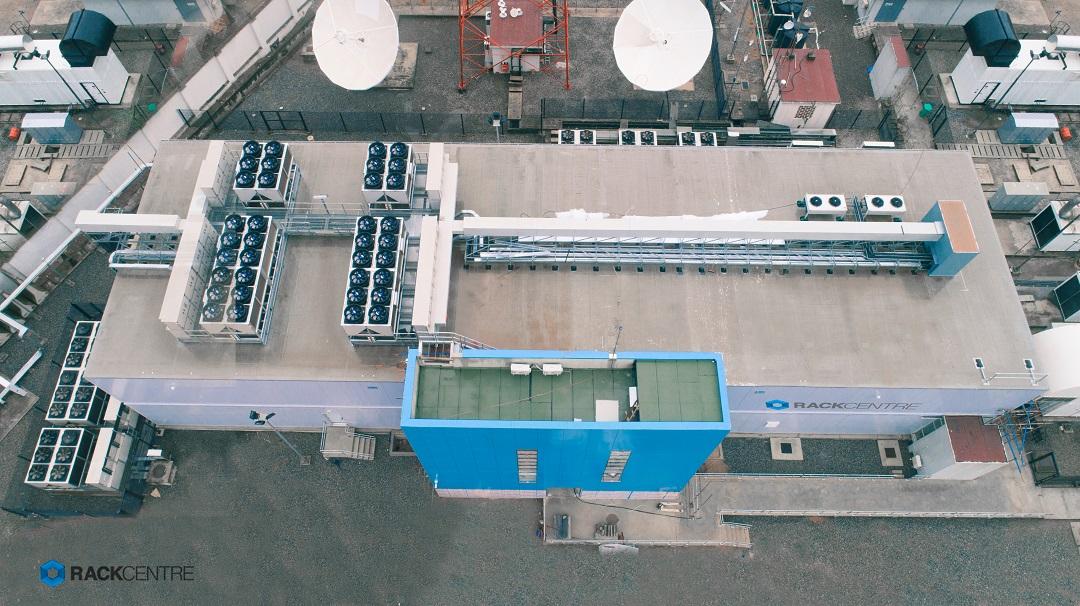
Nigeria's payment-data localisation deadline looks straightforward when reduced to one sentence: payment transaction data generated in Nigeria must be stored and managed in Nigeria from 1 January 2027.
At the level of a modern payment architecture, it is considerably less straightforward.
A payment transaction does not normally produce one record that remains inside one database. The same transaction can generate copies and derivatives across databases, replicas, backups, disaster-recovery environments, application logs, fraud-detection systems, analytics platforms and third-party processors.
That distinction changes the question.
The issue is not simply:
Where is the primary database?
The engineering question is:
Where can payment information exist, where can computation occur on it, who can receive or access it, where can it leave the country, and when does every copy eventually disappear?
That is the question this analysis examines.
The AAT Payment Data Lifecycle Localisation Framework
AAT Intelligence evaluates localisation across the complete lifecycle of payment information rather than treating the location of the primary database as a proxy for compliance.
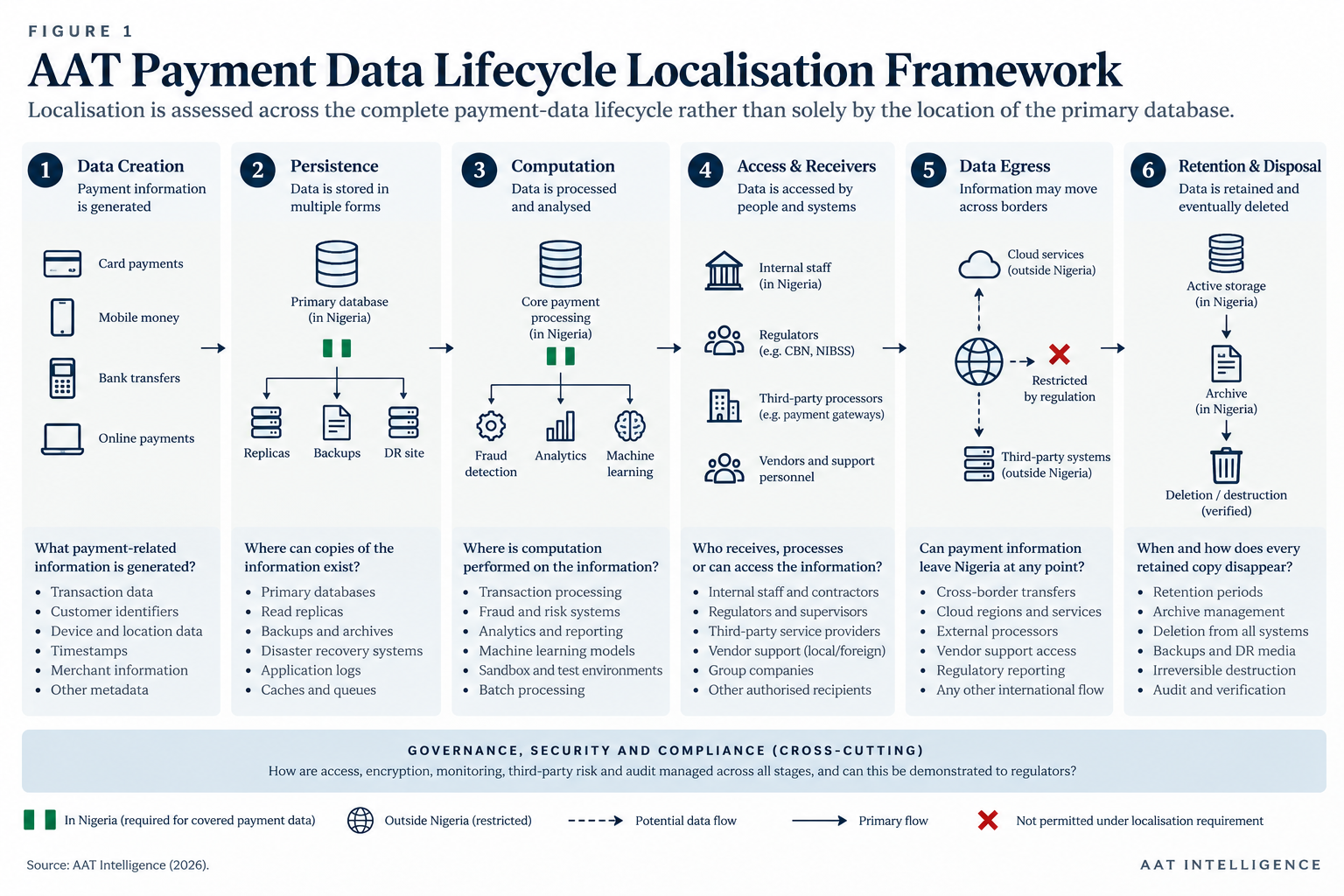
AAT Payment Data Lifecycle Localisation Framework. Localisation is assessed across the complete payment-data lifecycle rather than solely by the location of the primary database.
The framework follows payment information across six layers:
| Stage | Engineering question |
|---|---|
| 01 — Data Creation | What payment-related information is generated? |
| 02 — Persistence | Where can copies of that information exist? |
| 03 — Computation | Where is computation performed on the information? |
| 04 — Access & Receivers | Who receives, processes or can access it? |
| 05 — Data Egress | Can payment information leave Nigeria at any point? |
| 06 — Retention & Disposal | When and how does every retained copy disappear? |
At every layer, AAT Intelligence asks what information exists, where it is stored, where it is processed, who can access it, whether it can leave Nigeria, and how every retained copy is eventually deleted, destroyed or irreversibly de-identified.
Sources
Central Bank of Nigeria
Circular PSS/DIR/PUB/CIR/001/004. Regulatory basis for the 1 January 2027 payment-data localisation requirement.
NITDA
National cloud and digital infrastructure regulatory instruments · 2026
Regulatory context for cloud governance, infrastructure assurance and provider certification in Nigeria.
AWS
AWS Regions and Availability Zones · Accessed September 2026
Primary AWS documentation used to distinguish full AWS Regions from other infrastructure footprints.
AWS
AWS Local Zones features · Accessed September 2026
Primary AWS documentation for services available through Local Zones, including Lagos.
AWS
AWS Direct Connect locations · Accessed September 2026
Primary documentation for AWS connectivity infrastructure.
Microsoft
Azure Front Door edge locations · Accessed September 2026
Primary Microsoft documentation for Azure edge presence.
Microsoft
List of Azure regions · Accessed September 2026
Primary Microsoft documentation used to distinguish Azure Regions from edge/network locations.
Google Cloud
Google Cloud network edge locations · Accessed September 2026
Primary Google documentation used to identify network-edge presence and distinguish it from regional cloud infrastructure.
Rack Centre
Lagos Data Centre Campus — LGS2 Expansion · Accessed September 2026
Operator disclosure for Rack Centre's Lagos infrastructure.
Africa Data Centres
Lagos Data Centre · Accessed September 2026
Operator disclosure for the Lagos facility.
Open Access Data Centres
OADC Lagos · Accessed September 2026
Operator disclosure for OADC Lagos infrastructure.
BusinessDay
Banks ready, fintechs lag as Nigeria's 2027 data localisation deadline nears · 29 July 2026
Source for the attributed industry claim that major banks are further advanced in localisation than fintechs. AAT Intelligence treats this as a claim rather than independent evidence of institution-level compliance.
TechCabal
CBN's local data order puts Nigeria's data centres to test · 7 July 2026
Industry reporting on Nigeria's data-centre capacity and localisation requirement.
Topics
- Payments
- Cloud
- Infrastructure
- Regulation
- Nigeria
- Fintech
Related
From Vision to Infrastructure: What Would It Take to Build the Future Elon Musk Shared?
Sep 20, 2026 · 5 min read
Nigeria's AI Infrastructure Ambition: What Has Actually Been Built?
Sep 18, 2026 · 9 min read