From Vision to Infrastructure: What Would It Take to Build the Future Elon Musk Shared?
Elon Musk shared an AI-generated vision of humans, machines and settlements expanding beyond Earth. AAT Intelligence examines the infrastructure behind that vision — separating what has been demonstrated, what is under development and what remains speculative at scale.
On 20 September 2026, Elon Musk shared a futuristic short film on X with a short declaration:
“This is the future we shall bring into being.”
The imagery is striking: humans working alongside artificial intelligence, humanoid robots, large-scale engineering beyond Earth and settlements extending progressively farther from the planet.
But the video is not a SpaceX mission architecture or a Tesla engineering roadmap.
It is Age of Beyond, a speculative AI-generated short film created by Aze Alter.
That distinction matters.
The interesting question is not whether the future depicted in the film is visually compelling.
It is:
What physical infrastructure would have to exist for anything resembling that future to become possible?
And how much of that infrastructure exists today?
A vision is not an engineering roadmap
Futuristic imagery has a useful property: it removes the intermediate steps.
A city appears on another world.
A humanoid robot walks through it.
Spacecraft move between destinations.
Artificial intelligence operates alongside humans.
What disappears between those scenes are decades of infrastructure.
A functioning off-Earth civilization would require multiple technological systems to mature simultaneously:
Transportation. Large quantities of equipment, materials and eventually people must be moved beyond Earth economically and repeatedly.
Energy. Settlements need continuous power generation independent of terrestrial infrastructure.
Robotics and autonomy. Machines would need to perform construction, maintenance, inspection and industrial tasks in environments where sending human labour is expensive or dangerous.
Compute and communications. AI systems, navigation, communications and autonomous machinery require substantial computing and networking infrastructure.
Resource extraction. A settlement that depends indefinitely on material shipped from Earth remains constrained by Earth's launch capacity.
Manufacturing. Extracting resources is insufficient unless those resources can be converted into useful structures, components, fuels and replacement parts.
Human-support systems. Air, water, food, thermal management, radiation protection, medical capability and waste processing would have to operate reliably for long periods.
The difference between a mission and a civilization lies largely in whether these systems can operate repeatedly without continuous rescue from Earth.
Transportation: necessary, but not sufficient
SpaceX's Starship provides one of the clearest connections between Musk's statement and an active engineering programme.
SpaceX is developing Starship as a reusable transportation system intended to carry people and cargo to Earth orbit, the Moon, Mars and potentially beyond.
That matters because a sustained presence beyond Earth requires moving infrastructure, not merely astronauts.
Habitats, power systems, vehicles, construction machinery, communications equipment, scientific instruments and replacement components all have mass.
Reducing the cost and increasing the frequency of transporting that mass is therefore foundational.
But transportation alone does not create a settlement.
A rocket can deliver a power system.
It does not make that power system operate autonomously for decades.
Robotics: increasingly real, but far from the depicted scale
The film depicts artificial and biological intelligence operating together almost as ordinary components of civilization.
Humanoid robotics is one area where the boundary between science fiction and active industrial development has narrowed.
Tesla is developing Optimus as a general-purpose humanoid robot and has discussed plans for progressively larger-scale production.
But a terrestrial humanoid robot and an autonomous robotic workforce capable of constructing and maintaining extraterrestrial infrastructure are profoundly different engineering achievements.
An off-Earth robot could need to operate under dust, radiation, temperature extremes, communications delays and limited opportunities for human repair.
The relevant milestone is therefore not simply:
Can a humanoid robot walk and manipulate objects?
It is:
Can autonomous machines perform economically useful work reliably for long periods in environments where human intervention is difficult?
That capability has not been demonstrated at the civilization scale implied by the film.
Energy may be the less visible constraint
Every futuristic city is ultimately an energy system.
Transportation requires energy.
Compute requires energy.
Mining requires energy.
Manufacturing requires energy.
Life support requires energy.
This is one reason futuristic imagery can obscure the hardest parts of infrastructure.
Buildings and robots are visible.
Electrical generation, storage, distribution, redundancy and maintenance usually are not.
Yet the latter determine whether the former can operate.
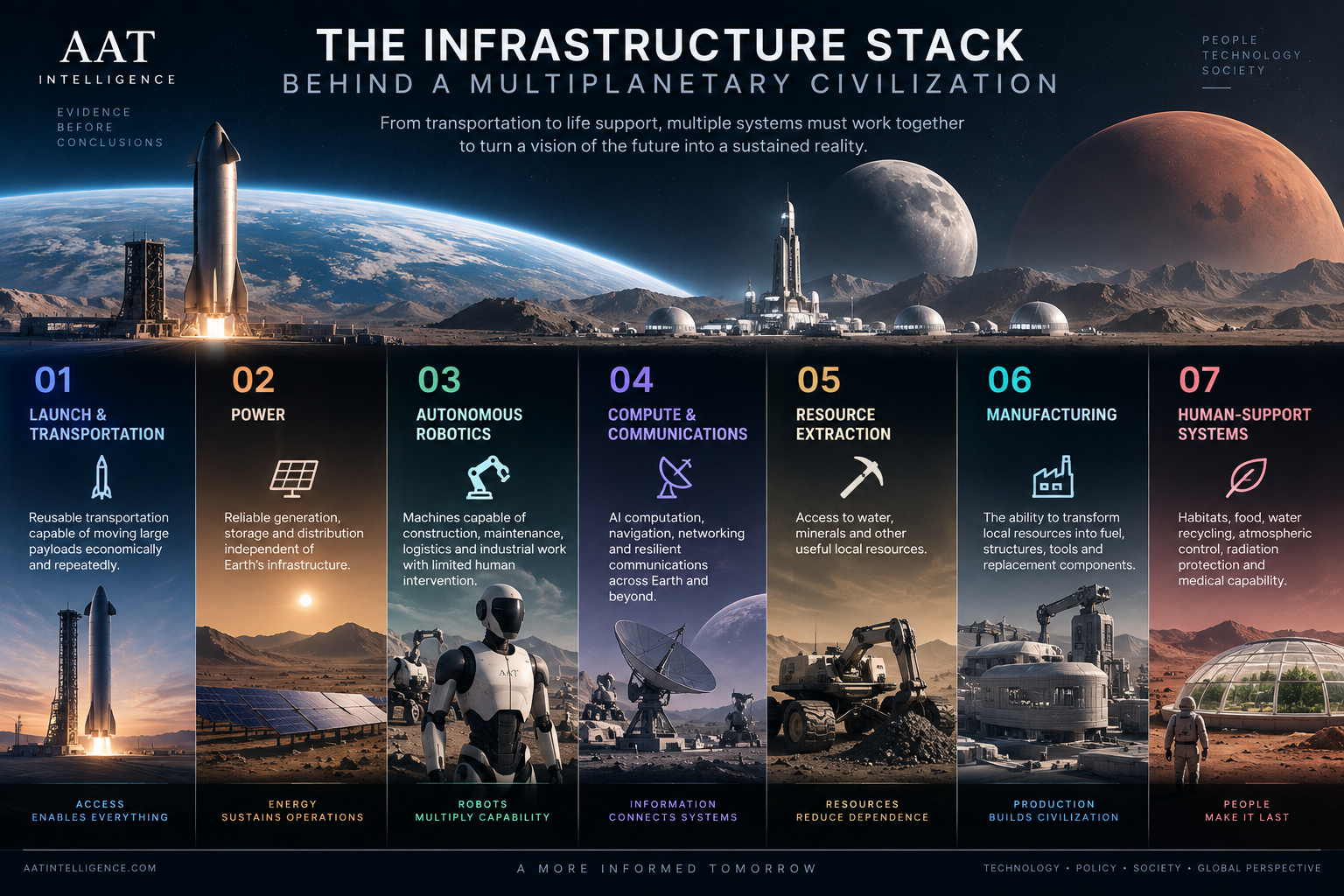
The infrastructure stack
A useful way to interpret the future depicted in Age of Beyond is not as a single technological prediction, but as an infrastructure stack.
01 — Launch and transportation
Reusable transportation capable of moving large payloads economically and repeatedly.
02 — Power
Reliable generation, storage and distribution independent of Earth's infrastructure.
03 — Autonomous robotics
Machines capable of construction, maintenance, logistics and industrial work with limited human intervention.
04 — Compute and communications
AI computation, navigation, networking and resilient communications.
05 — Resource extraction
Access to water, minerals and other useful local resources.
06 — Manufacturing
The ability to transform those resources into fuel, structures, tools and replacement components.
07 — Human-support systems
Habitats, food, water recycling, atmospheric control, radiation protection and medical capability.
Remove any one of these layers and the system becomes substantially more dependent on Earth.
Demonstrated, developing and speculative
The useful analytical distinction is not between “possible” and “impossible.”
It is between different levels of demonstrated capability.
Demonstrated
Reusable rocket stages have been demonstrated.
Industrial robots already perform economically useful work.
Large-scale energy storage, solar generation, AI computing and increasingly capable autonomous systems exist on Earth.
These are real technologies.
Developing
Fully reusable super-heavy launch systems.
General-purpose humanoid robots.
Large-scale autonomous industrial operations.
In-space refuelling.
Long-duration infrastructure designed for sustained lunar or Martian activity.
These have active development pathways, but important engineering and economic questions remain.
Speculative at the depicted scale
Self-sustaining cities on Mars.
Industrial-scale extraterrestrial resource extraction.
Large permanent settlements across multiple planetary bodies.
Civilization-scale autonomous construction beyond Earth.
Human societies operating substantially independently of Earth's industrial base.
The existence of technologies in the first category does not automatically establish a path to the third.
The infrastructure connecting them is the real story.
The distance between vision and reality
There is value in technological visions.
They can provide direction before every intermediate engineering problem has been solved.
But analysis requires separating what can be imagined from what can be demonstrated.
Musk's post is interesting because portions of the depicted future overlap with technologies already under active development: reusable space transportation, humanoid robotics, artificial intelligence, autonomous systems and energy technologies.
That does not make Age of Beyond a roadmap.
It makes it a useful thought experiment.
The engineering question is not:
Can we imagine this future?
We clearly can.
The harder question is:
Can transportation, energy, robotics, compute, manufacturing and human-support infrastructure become sufficiently reliable, scalable and economical to sustain it?
That is where vision becomes infrastructure.
And that is where a few minutes of futuristic imagery become a decades-long engineering problem.
Sources
Aze Alter
Age of Beyond: If Humans & AI United · 2025
Original speculative AI short film later shared by Elon Musk.
SpaceX
Starship · Accessed September 2026
Primary SpaceX material describing Starship's architecture, intended applications and payload capabilities.
SpaceX
Mars & Beyond · Accessed September 2026
Primary SpaceX material describing infrastructure and industrial requirements associated with sustained activity on Mars.
Tesla
Tesla investor and company disclosures · Accessed September 2026
Primary company disclosures used to assess the development status of Tesla's Optimus humanoid robotics programme.
Topics
- Space
- Artificial Intelligence
- Robotics
- Infrastructure
- Energy
- Computing
Related
What Does “Localised” Actually Mean? Inside Nigeria's 2027 Payment-Data Mandate
Sep 19, 2026 · 2 min read
Nigeria's AI Infrastructure Ambition: What Has Actually Been Built?
Sep 18, 2026 · 9 min read